

(Way)Background Information
I’ll tie Fender into this shortly, but first some important background…
Antonius Stradivarius lived and worked in Cremona, Italy from 1644 to 1737. The wood he used in his famous violins came from the Fiemme valley in the Italian Dolomite Mountains region in the north of Italy, about 250km from Cremona. The trees he used were likely 150-250 years old, and are referred to as “European spruce.” European spruce grows very straight and has a very distinctly different winter and summer grains, which makes the spruce from that region ideal for acoustic instrument tops.
When you look at a piece of any wood, the slower-growing winter grain is darker, narrower, and more dense than the summer grain. The winter grain are the dark lines in the wood. The faster-growing summer grain is lighter, wider, and less dense than the winter grain. In other words, the environment in which a tree grows has a lot to say about the precise structure of its wood.
From a functional standpoint, when you cut it in the usual way for instrument tops, where the grain lines run parallel to the length of the instrument, it’s more rigid from end to end, but more flexible side to side. This means the wood has strength where it’s needed against string tension, but also the flexibility needed for its acoustic performance.
As an aside, there’s a study called “dendocronology,” which studies the annular rings of a tree – or, otherwise the lines in the top of an instrument – which leverages a lot of historical data, and as such, can fairly accurately identify when a certain piece of wood lived. This is actually one of the techniques used to verify the authenticity of a Stradivarius violin, because they can pretty accurately date a piece of European spruce. We digress a bit, but all this is to give you a sense of the importance of not just the type of wood used, but also where the wood came from, when discussing an instrument where acoustic characteristics are a significant component to its design. This leads us to the bass in front of us in this review.
The Company Line
In the product literature, Fender only refers to a “legendary artisan,” but as it turns out in my research, Antonius Stradivarius is who they’re talking about. I imagine it was too sensitive of a name to publicize with, so they played safe (which I would agree with, if that’s the case). But in this Suona product line, they’re specifically trying to pay tribute to Antonius Stradivarius’ work by not only limiting the finishes to a traditional orchestral string instrument aesthetic, but also in their wood selection. As it turns out, Fender acquired the topwood pieces for these instruments from the Fiemme Valley, just as Stradivarius did. Generations later, of course, but in essence the same family of trees, hopefully leveraging a pedigree from the trees Antonius used.

So where did that crazy name come from? It actually comes from the nickname of that forest where its top comes from. That forest in the Fiemme Valley is often referred to as the “Bosco che Suona,” or “the Sounding Forest” (in Italian suona means “it sounds”). The name Suona comes from that reference.
Details
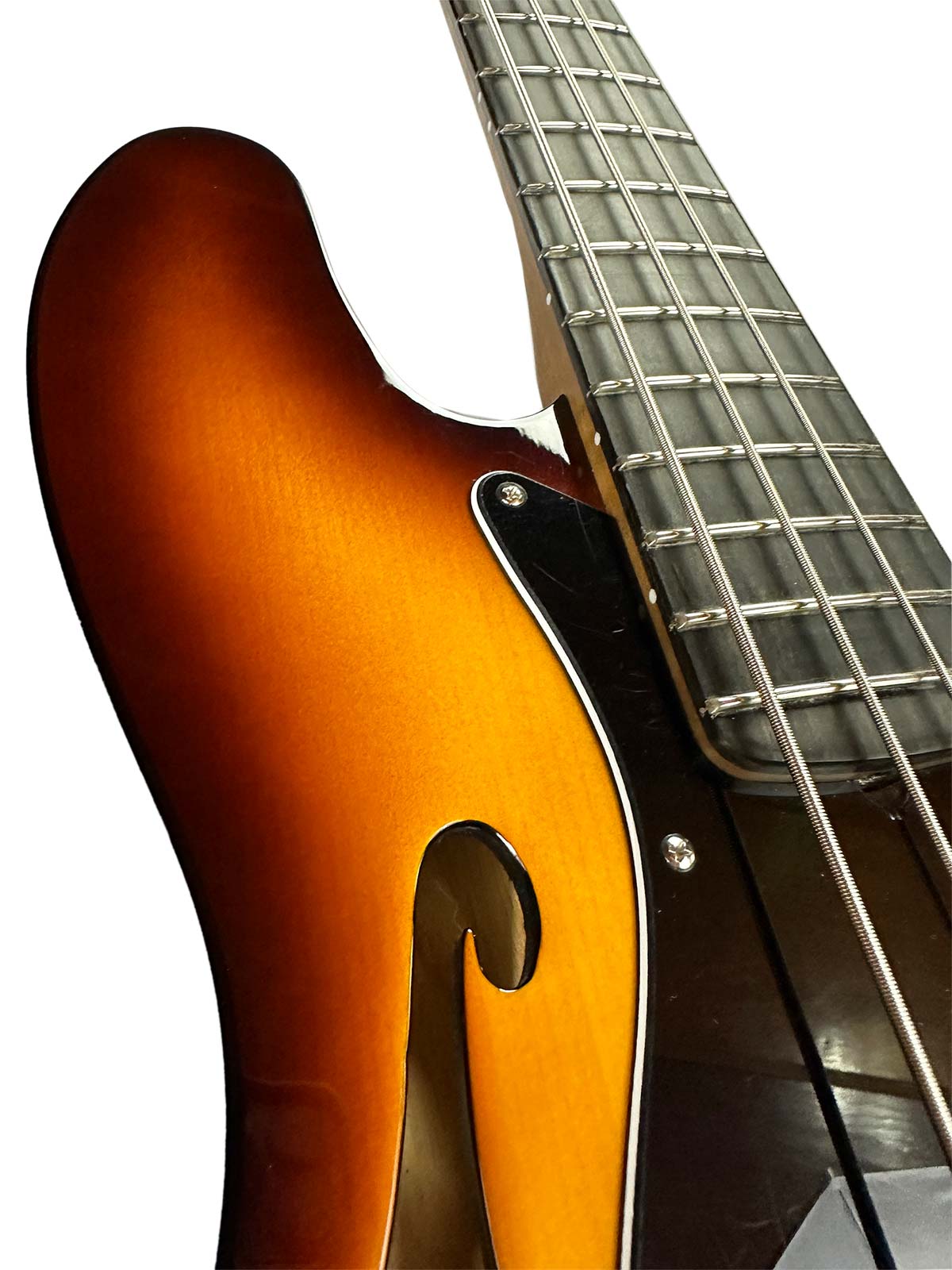
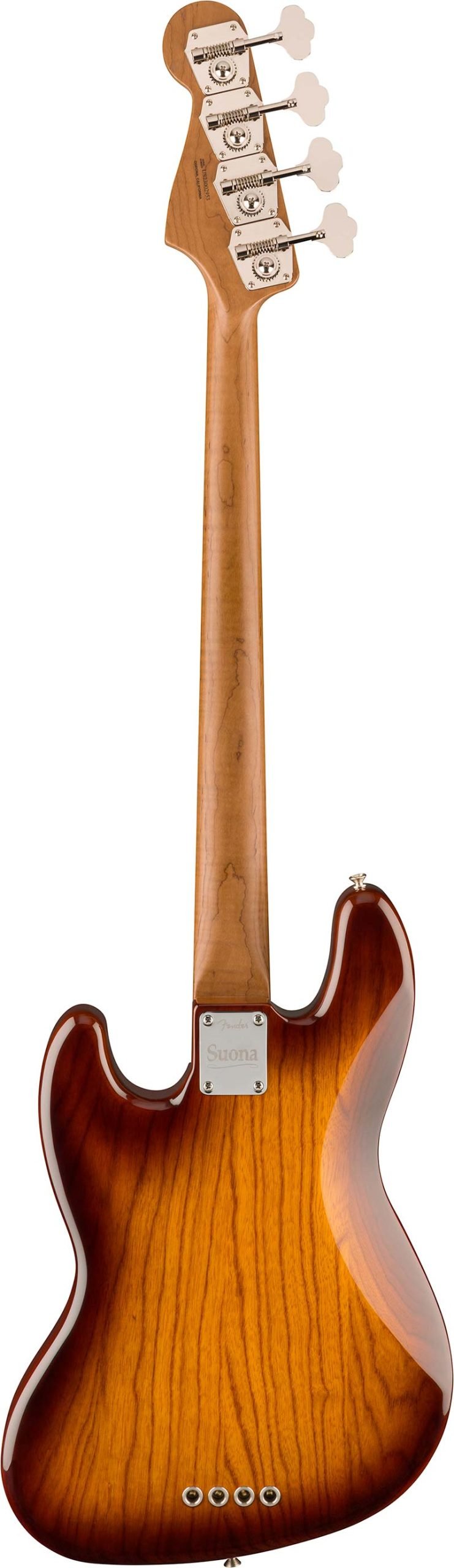
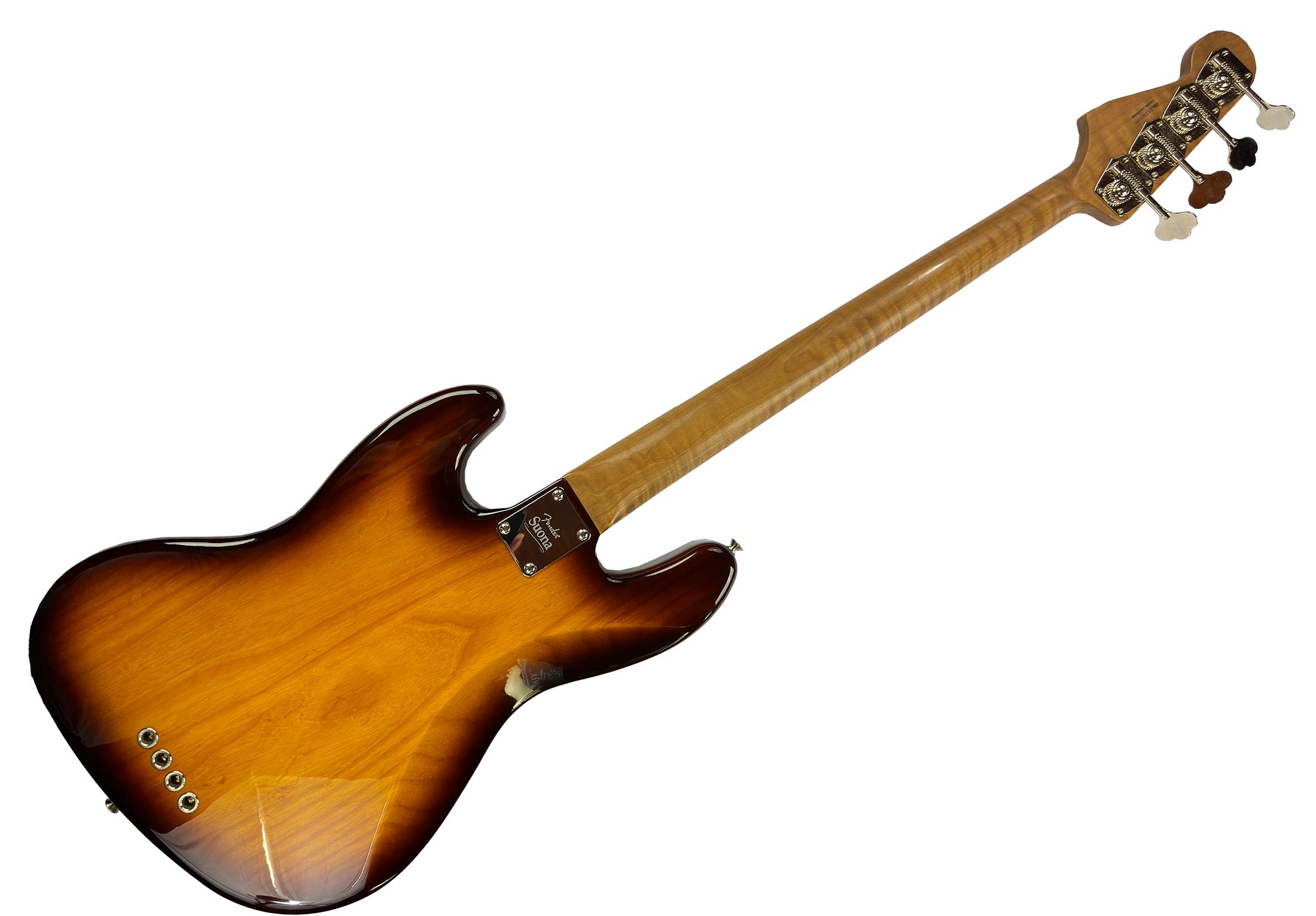
Fender won’t release its design details, but from what I can tell doing the tap test and looking through the f-hole, it appears to be a pretty intricate design for a Thinline-style instrument. It seems like every chance they got, they hollowed out the ash body, and unlike all the other Thinline style instruments I’ve seen, where the body is a simple “slab” shape, this one has a contour cut on the back – which, of course, must be followed by the internal carving. They seemed to only have it solid where they needed to … mainly for hardware support and strength against string tension. So, they worked really hard to keep that top very involved in the sound. Also, as far as I can tell, this is the first Thinline bass Fender USA has ever made. The closest thing I could find was a Fender Japan made Precision Bass “PBAC-100.” It has a slab-shaped body as expected, but that bass looks as if it’s a full acoustic top, instead of an actual Thinline, which is more of a semi-acoustic design. I’m betting PBAC stands for Precision Bass ACoustic. It also has a mahogany body instead of ash, like this one has. In fact, before researching for this review, I’d never seen or heard of one before.
I did ask Fender why they went with an ash body, instead of something more classic, such as alder, or maybe even mahogany:
“For two reasons, really. We loved the tone of the spruce top/ash body combination. The ash really added some nice high end to complement the warmth of the spruce. Also, as you know, ash has a beautiful grain pattern that looks fantastic with a transparent finish.”
I also asked about the ebony board, versus something more traditional for a Jazz Bass, and Fender replied:
“We love the tone of ebony, and it has a very comfortable smooth feel. It is bright and responsive and mates well with the warm-sounding spruce top. In addition, the overall design of the bass was very much inspired by the fact that Stradivari used Italian spruce for his violins. We wanted to give a nod to the look of a fine violin – with an f-hole and a dark ebony fingerboard, with no position markers.”
Of course, once I understood the violin theme, that also fits, since most all stringed instruments also have ebony fingerboards, with no markers. Speaking of the theme, I asked them to expand on the overall inspiration:
“We were inspired by the fact that we had an opportunity to use wood harvested from the same forest that Stradivari sourced from – that’s when we decided to design an instrument that pays homage to the look of a violin. That really set the tone for the whole series. We chose our lacquer violin burst finish (of course!) over that wonderful black bound spruce top and ash back – it came out beautifully. We made sure the bodies were semi-hollow with f-holes. We used ebony fingerboards with no position markers, and to top it off we painted the headstock to match the body and loaded the instruments with premium custom-voiced pickups. We sourced the wood nearly three years ago and the guitar team came up with the design shortly after that.”
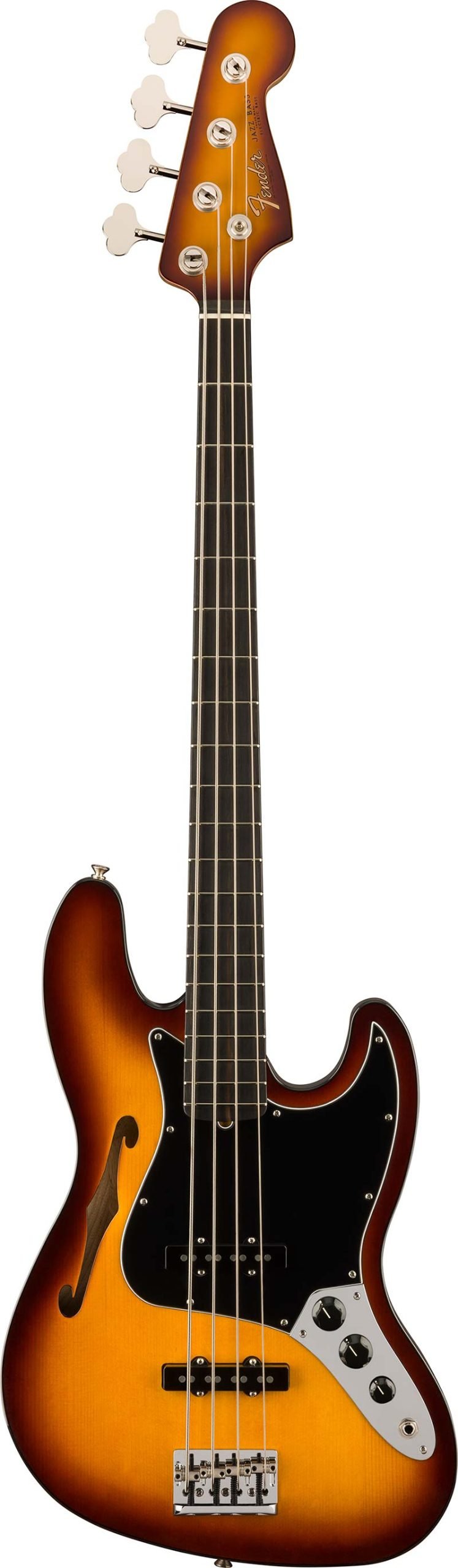
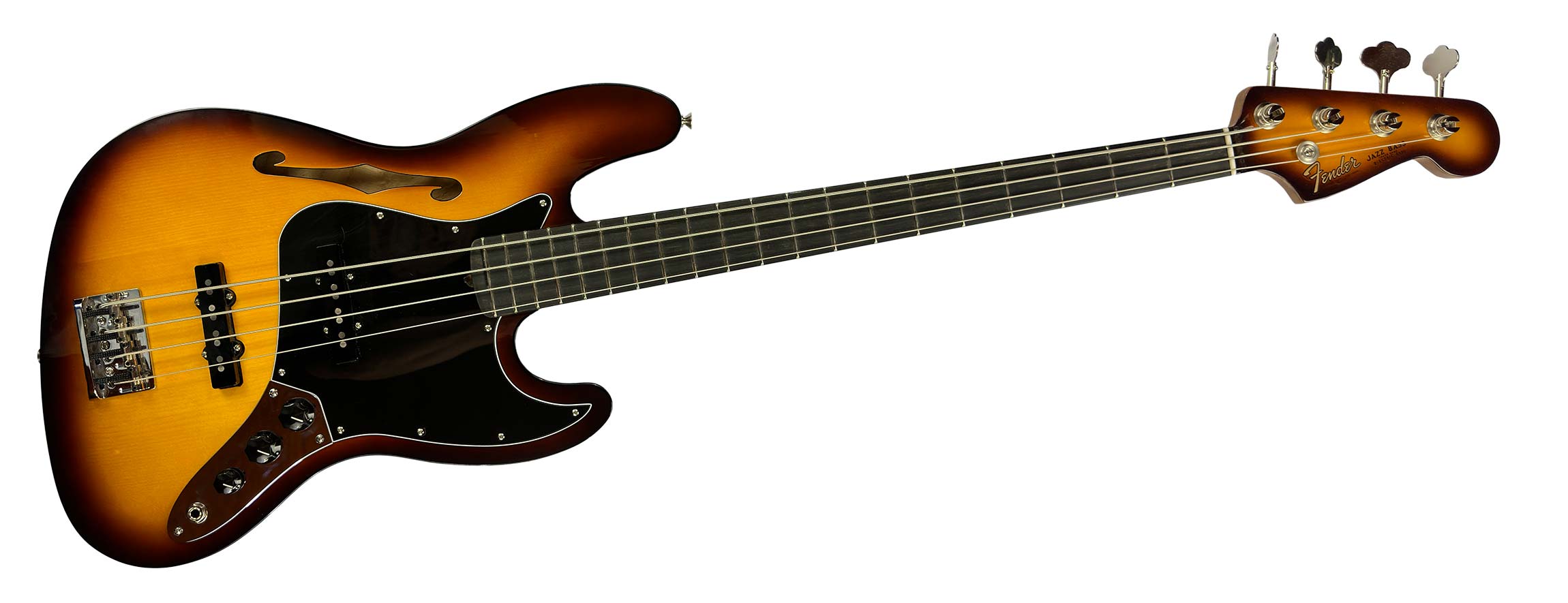
As I mentioned above, this bass has a carved semi-hollow ash body with a comfort contour on the back. It also has the forementioned Fiemme Valley sourced Italian spruce top, finished in a traditional violin burst, done in nitrocellulose, with black binding. It has a roasted flame maple neck with a modern “C” profile. The fingerboard is ebony, with a compound radius that goes from 7.25” at the nut, to 9.5” at the heel. The headstock also sports the same nitrocellulose violin burst finish. It has 20 narrow tall nickel silver frets, a bone nut, and a round string tree over the D and G strings.
The bridge is their newer HiMass™ Vintage bridge. The pickups are their brand new custom-designed Suona Jazz Bass single-coil pickups. I also asked Fender about the pickup design and voicing, since these are new, and specifically designed for this instrument:
“The unique combination of an Italian spruce top/ash back with an ebony fingerboard was new territory for us. We experimented with several different sets of pickups to achieve just the right tonality to match the woods. We landed on a vintage-style ‘60s Jazz Bass set modified with Alnico 2 magnets.”
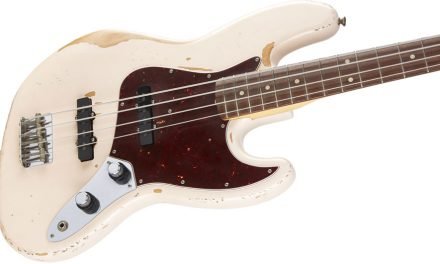
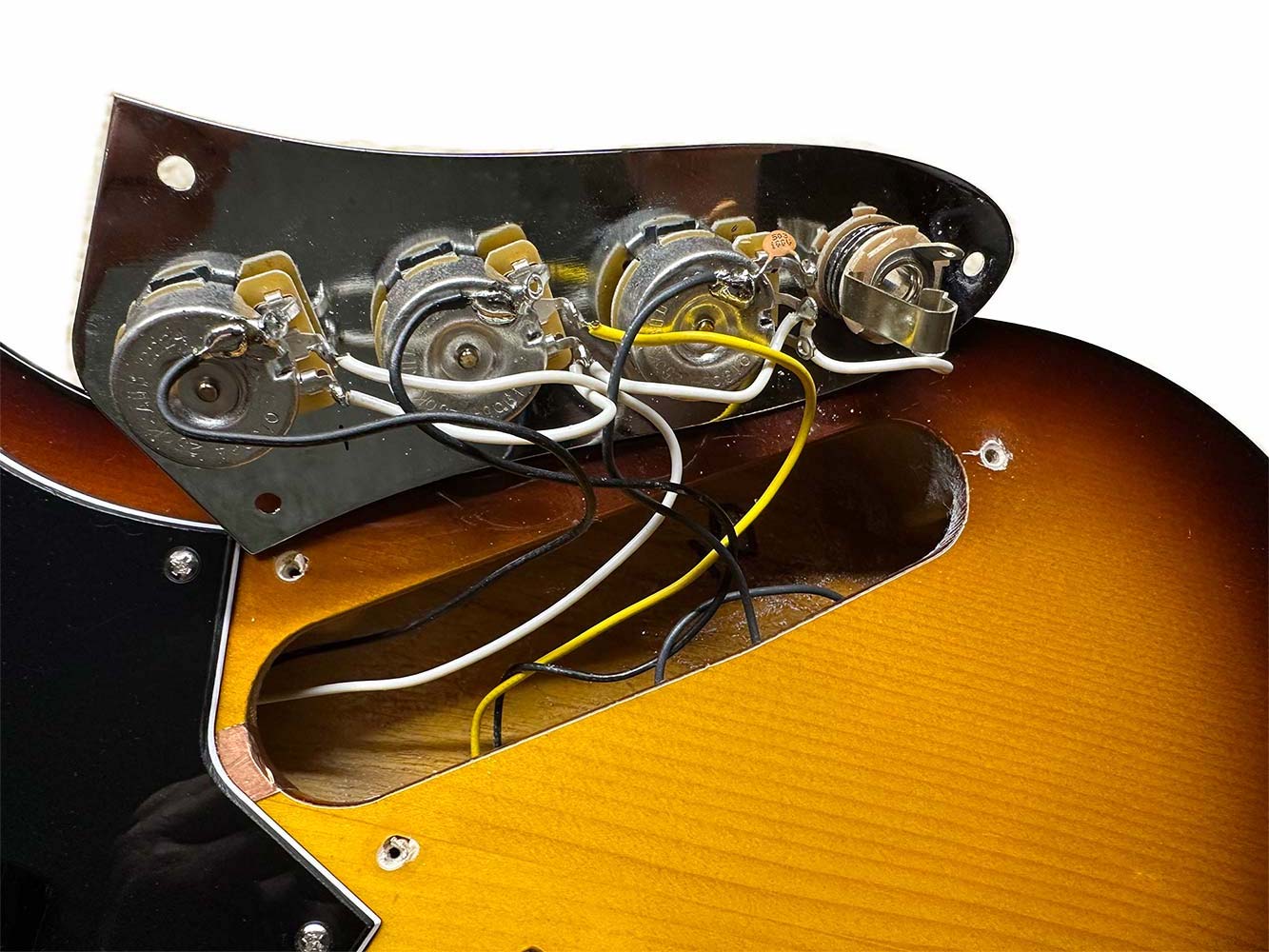
The strap buttons are the typical cone style, the knobs are classic Jazz Bass style black plastic. The wiring is under a chrome control plate, and the controls are classic Jazz bass “volume-volume-tone,” where the first control is for the neck pickup, the control in the middle is for the bridge pickup, and the smaller control closest to the output jack is the standard vintage style tone control. It has a three-ply black-white-black pickguard and a custom Suona neck plate.
Fit and finish
The finish is flawless and beautiful, and I love that they did the vintage logo on the headstock. The satin finish roasted flamed maple neck is not only a perfect callback to the violins this bass pays homage to, it also feels great in the hand. The fretwork is spot on with a very good level, rounded and polished, with nice clean work on the edges and the nut is very well done. The fingerboard is nicely rounded and a beautiful piece of ebony with just some nice hints of color and comfortably rolled edges (sidebar, if you haven’t seen Bob Taylor’s video on ebony, you should seek it out. It’s excellent). There is a very slight gap on the top horn side of the neck pocket, but otherwise, it’s a perfect fit. The nut is very well done with nicely rounded edges.
The bridge that’s on this bass is one of my favorites that Fender has ever done. It’s very easy to adjust, helps with compression and sustain, and looks great. The reverse low-ratio tuners are an understandable callback to the vintage Jazz Basses of yesteryear, so they fit the theme, but even though I had no problems tuning the bass, I still would have preferred a higher-ratio option. The reverse nature doesn’t bother me at all, however.
The controls are simple, work perfectly, and exactly as expected. Even though this bass doesn’t really have any “electronics” so to speak, I pulled the control plate to see what’s there. The wiring looks fine, and I was initially surprised to find no shield paint, but then I realized it’s because it’s mounted on one of the open acoustic chambers, which would make it pretty much impossible to make the usual “shield can” a typical shield foiled/painted control cavity route could provide. However, I believe the pickup routes are shielded, as there is some foil connecting to the control plate, which I assume grounds the “shield cans” of the pickup routes. I didn’t want to yank the pickups out to verify this, but it kind of has to be the case, because this bass is surprisingly quiet for having single-coils. In fact, I had to ask Fender to verify that aspect.
On the gig
At 8.2lbs, this bass is a feather on the shoulders and balances perfectly. Since this one only has a contour on the back due to the Thinline semi-acoustic design, I do notice the lack of a contour on the front, like a solid-body Jazz Bass has, but with how thin the body is, it’s not an issue. This is such a superb instrument, especially for not being a Custom Shop model. I wish I had a lot more to say about its tone and behavior, but this bass isn’t about features. It’s about style, quality, and fundamental tones. Anyone with any experience with a standard passive Jazz Bass will be right at home with this one.
Where I feel it stands out is the warm, full, round, smooth, and clear voice it has, regardless of the pickup blend. Yeah, the bridge pickup has very a nice edge, and the neck pickup has all the earth and girth you need, but it’s not going to bite your head off when slapping, and it’s not going to blow woofers on the low end. There’s just not enough o’s in smooth to describe this bass. I also have to re-iterate as I said before, for single-coil pickups, this bass is surprisingly quiet. This is really important to me in particular, because even in my solid-body electrics, I strongly prefer the sound of single-coils when it comes to Jazz Bass-style pickups. The neck feels as good or better than any other Jazz Bass I’ve played. The combination of the modern C profile, the satin finish, and the compound radius just make it a joy to play.
My favorite application for this bass is jazz, though I also played it in church and the rock band (which also plays a little country). I just loved its voice on the jazz standard ballads, and the smoothness of its edgy tone on the bridge for the snappier stuff. You can very definitely hear the involvement of the spruce top, which just makes it even better. It adds a nice acoustic instrument “ambience” to the tone, for lack of a better way to describe it. If you’ve ever played a dreadnought-style acoustic bass guitar, that’s what I’m talking about, but of course more of an added color, not a dominating tone. This is still an electric Jazz Bass, first.

The Bottom Line
| Company: | Fender Musical Instruments Corp. |
| Website: | https://www.fender.com/ |
| Made in: | USA |
| Price: | $3,099.99 |
| Options: | None |
| Accessories: | Deluxe blonde hardshell case |
| Warranty: | Limited, 2 years |
| Body Wood(s): | Semi-hollow ash with Italian Alpine spruce top |
| Body Finish: | Gloss nitrocellulose lacquer violin burst, with single-ply black top binding |
| Neck Wood(s): | Roasted flame maple |
| Neck Finish: | Satin nitrocellulose lacquer with (body) matched headcap |
| Neck Shape: | Modern "C" |
| Neck Attachment: | 4-bolt standard (at heel) |
| Scale Length: | 34” |
| Fingerboard: | Ebony |
| Fingerboard Radius: | 7.25" to 9.5" vintage compound radius |
| Number Of Frets: | 20 |
| Position Inlays: | n/a |
| Side Dots: | White |
| Strings: | Fender USA 7250M nickel plated steel |
| Gauge: | .045, .065, .085, .105 |
| Attachment: | At bridge |
| Bridge/color: | Hi-Mass™, chrome |
| Nut (Guide): | Bone |
| Nut width: | .5” |
| Tuners/color: | Pure Vintage reverse open-gear cloverleaf, chrome |
| Knobs/color: | Knurled flat-top, chrome |
| Pickguard: | 3-ply black/white/black |
| Control cavity cover: | Chrome plate on front, pop-out battery boxes on back |
| Neck plate: | 4-Bolt with custom Suona logo |
| Truss Rod: | Heel adjust, 3/16" hex |
| Pickups: | Custom-designed Suona single-coil Jazz Bass® |
| Controls: | Volume (Neck Pickup), Volume (Bridge Pickup), Tone |