PX is UX, tuned for players: in digitally-controlled gear, DSP is a solved problem. Player Experience is the new differentiator.
By Sean Fairchild
Here’s a confession that might cost me my gearhead card: tone is no longer the paradigm.

Software-based and digitally controlled instruments and effects now live or die by their user experience (UX), not their audio performance. DSP is a mature technology; the bar for sound quality sits high across every serious name in the market. So while tone is the first metric we measure when we investigate digital gear, it has quietly lessened as the primary one that decides which of several similar items you should buy. What actually determines whether a box earns a permanent spot on/replaces your board – or gets flipped on Reverb® or TalkBass™ inside a month – is how it feels to use: how intuitive the interface is, how inviting it is to dig into, how gracefully it bends to the way you actually work. Call it the “Player Experience: PX.” I’d argue that’s the true scale now, and it’s the lens through which I’ll look here, trained on the digitally-controlled, in-the-box gear so many of us lean on.
From UX to PX
This is exactly why I spent a week of June in a San Francisco convention center packed with 10,000 product designers. By day, rather than pushing serious air, I’m pushing pixels as a Senior Product Designer at Warner Bros. Discovery®. A Bass Gear Magazine media pass bestowed by Figma®’s Comms team, paired with that design background, was my ticket into Figma’s Config 2026 conference and its invite-only Leadership Collective.
Figma, if you’re unfamiliar, has become one of the most popular digital design software platform around the globe over the last ten years. The app you’re using to read this? Good chance it was designed in Figma. As well as virtually all of your mobile and many of your desktop apps. And Figma matters to us more than its name lets on, because PX has to be designed somewhere, by someone – and more and more, that somewhere is Figma, the tool roughly 95% of the Fortune 500 lean on.

Player/gear interaction
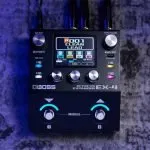
Look at what’s crossed my desk lately and the pattern is hard to miss. The IK Multimedia TONEX ONE Bass Edition is a whole amp-and-effects ecosystem run from software and a companion app. Fender®’s Tone Master Pro is essentially a big touchscreen with a pedalboard attached. Fractal®’s FM9 Mark II Turbo and VP4 Virtual Pedalboard, the BOSS GX-10, and the Line 6 Helix family – which I gig with myself – all win or lose on their displays and companion editors as much as their algorithms. The newest flagships increasingly ship full touchscreens, which pulls their design straight into phone and app territory: the same gestures and interaction design, the same conventions, the same product design playbook. The tone in every one of them is excellent; so much so, that I’d wager a whole paycheck on virtually anyone’s inability to correctly and consistently pick the correct one out of a blind “taste test.” What sets them apart is the PX they impart.
This framing fit Config 2026 better than I expected! For a conference that launched a staggering amount of AI, it spent most of its breath insisting on the human element – on the taste and judgment that no model supplies. Swap “tone” in for “design,” and the whole event reads like an argument for PX. It helped that Figma’s Chief Design Officer, Loredana Crisan, came up through a musical background and career similar to myself prior to design; a classically trained pianist and composer, conservatory schooled in Bucharest, who passed through sound engineering on her way to product. While we didn’t get the chance to interface (pun intended) directly at the show, there were at least two of us in the room who think about sound and screens in the same breath when we did cross paths.

Living in a material world
Figma CEO Dylan Field opened this 10th gathering with a simple reframe: everything is a material. For musicians specifically, the news was in the toolbox, because these are the tools that will build the next generation of gear interfaces.
Figma Motion brought keyframe animation onto the design canvas. Those buttery meter sweeps and the screen that slides just so when you change patches can now be designed and fine-tuned in the same place the rest of the interface is built.
Shaders bring real-time glass, blur, and dimensional math to the canvas. That almost-liquid look on a premium modeler’s screen is how the next one will get there, with the designer shaping every parameter by hand instead of trying to spec an idea with a flat image to an engineer.
Code Layers put live code on the canvas and share the reasoning behind it with the whole team. Anyone who’s bought a pedal whose app looked gorgeous in the promo shots, but shipped feeling a generation behind, intuits the handoff gap this is intended to close.
Generative plugins, built just by describing them to Figma’s agent, let a two-person design boutique studio punch closer to the UI weight class of the big-name brands. My immediate, burning thought when seeing this: can Figma figure out how do this with audio?? Imagine prompting your own plugins for use in your DAW of choice!!

Arrangement view is alive and well
For a NAMM veteran, Config never felt like a foreign country. Wednesday’s product keynote handed off to Holly Herndon, a composer with a doctorate in computer music from Stanford, for a talk called “The Rules Are the Art: Creating with AI.” Her thesis – she calls it Protocol Art – is that the craft isn’t the thing the machine spits out; it’s designing the rule set, the constraints under which something worth hearing can happen. Anyone who’s spent a Saturday sculpting a signal chain, deciding what a rig will and won’t do before a single note, could feel that one land. Topically, she also co-founded Spawning, which builds consent tools so artists can decide whether their work feeds AI models at all; a fight coming for music whether we’re geared up for it or not.
The pull toward the middle
The conference closed with Grammy-winning artist and producer RAC (André Anjos), who got his start as a child in Portugal experimenting with a free music program bundled in a cereal box. A perhaps naïve but earnest request made through a band manager became a remix for The Shins, which became a career.
His thesis clearly articulated the human-in-the-driver’s-seat concept, harped on all week by virtually all presenters. AI, he argued, samples all of the creative output of humanity, and in doing so determines what the mean average is for a given subject matter – the safest choice – and happily produces that on command. But it does not merely produce the middling summation of human experience; it actively pulls you toward it, like gravity – a force that’s constant, ever-threatening, and never absent.
Initially, it draws you toward what everyone else is doing in your sphere. Later, once you’ve found some commercial viability, it persistently pulls toward the comfort of your own past work. The safe choice, previously proven by a measure of success. And he has been a victim of that pull, to his and his work’s detriment. But having travelled that road, he offered that the only thing that ever worked for him was doing the opposite: making the most pronounced, specific, personal and personally satisfying version of a thing. Use the tools where they genuinely help, with the realization that they cannot be genuine in and of themselves, and refuse the averaging. Be the version of yourself the machine can’t be. For any musician who’s ever worried about sounding generic, it’s an encouraging idea.

The Bottom Line
DSP and digital audio quality in general grew up. It’s mostly all great now; that war is effectively won. What a time to be alive! The next battle will be fought over experience – how a unit feels to interact with at 1am on a dark stage, and how quickly it gets out of your way and invites you to keep playing… or causes you to stop just to menu dive. Config 2026 was a great indicator of where that’s headed: more motion, more polish, a shorter trip from sketch to shipping, and more of it within reach of smaller builders. M.I being a small industry, that last part is key. The reassuring element, for an event I walked into half-expecting to feel replaced by robots, was how firmly everyone kept insisting the human still matters most. The floor has dropped; that much we’ve seen. With AI bands as well as product design. But the ceiling – great PX, and a sound that’s unmistakably yours – is still ours to raise.