As you may have heard, in 2024, Gibson unveiled the Tobias Original Collection of reissue basses. I was fortunate to be able to review two of these new instruments, the Classic IV reviewed herein, and the 5-string Growler V, which is featured in a separate review. This line of Tobias basses presents an opportunity for new players to connect with instruments tracing their lineage back to the original designs (Gibson acquired Tobias Guitars back in 1990). With two Bartolini® humbucking pickups, an 18V active preamp, and an ergonomic build, the Classic IV nods to ray-style instruments, but innovates with a fresh twist that only Gibson-era Tobias could concoct.
First Impressions
The Classic IV shipped in its included Tobias gig bag, and when I first opened it, I was thoroughly blown away by the tonewoods. The stunning combination of quilted maple (hard maple in the neck), wenge, walnut, and purpleheart not only brought a bespoke aesthetic, but seemed to promise a recipe for a superb sound. I immediately took a liking to the 5-piece stringer neck-through construction, noting how the neck felt so smooth and perfectly seamless with the instrument, especially with the comfortable ergonomics of the Tobias Asymmetrical neck profile (thick to thin from the E to G string). Before even plugging it in, I could tell that this bass was designed to play fast, and by contrast, it stood out with even more high-end appeal compared to its other Tobias Original Collection family members, with a higher retail price of $2,199 to accompany its upscale build.
While the aesthetics immediately checked out, I felt some drawbacks regarding the body shape and weight of this instrument. The specific bass that I reviewed came in at 9.2 pounds, making it more heavy than I prefer, particularly when combined with the body shape. While the body shape looks like it contours in a sleek manner, gravity caused this hefty bass to push into my body in some very uncomfortable ways while seated, making it a bass that I would prefer to play standing while using a wide strap. This is in sharp contrast with the Tobias Growler, which often comes in at 7 pounds or less, due to its extremely light paulownia body. These are subjective concerns, but worth noting as instrument weight and ergonomics can have a profound effect on playability.
Lastly, same as I experienced with the Growler V, I had nothing but appreciation for the inclusion of premium hardware. It is these fine details (alongside gorgeous woods and custom Bartolini electronics) that honor the boutique heritage of the Tobias brand. The gold-finished hardware and Babicz® bridge looked (and felt) deluxe, and the Gotoh® tuners proved rock solid. After plucking a few notes acoustically, I noticed that this bass already boasted supreme sustain and resonance, and I was eager to see how the Classic IV would deliver during my play test.


A Classic Shapeshifter
As I experienced with the Growler V, this bass did not come with documentation clarifying its controls, nor was there a manual available from Gibson. While it could be logical to assume that the controls follow the schematics of previous Tobias Classic IV models, I needed to confirm the layout before capturing sound samples to ensure accurate testing and prevent misinformation in this review.
Utilizing Bartolini’s wonderfully comprehensive online knowledge base, I once again located the official “2025 Gibson Tobias Classic & Killer B IV” schematics. To clarify any confusion about controls on the 2025 Tobias Classic IV, the core controls offer independent boost/cut of treble, midrange, and bass, alongside a pickup blend and master volume, making for a full-service onboard 3-band EQ/preamp experience. On top of this deep tonal flexibility, we have the mid frequency switch, which is a core part of the Tobias experience. On the Classic IV (as well as the Killer B), this switch contours the electronics’ response by setting the midrange focus of the preamp to 250Hz (up), 500Hz (flat), or 800Hz (down). A switch like this is a critical tool for optimizing the sound to accommodate a variety of playing techniques, especially when thumping and popping. Even though I play fingerstyle almost exclusively (with occasional use of a pick), I still found the mid frequency switch to be one of my favorite features of the Classic IV because of how it makes a tonal transformation so easy.
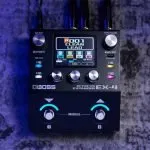
With the umbrellas of these three midrange frequencies in mind, I applied the Classic IV to a wide variety of musical genres, from disco to something more bluesy. I focused on blending the pickups in a way that would accentuate my onboard EQ preamp settings and match my intended musical style. As always, I recorded all samples into my DAW through the clean “Studio” patch of my BOSS GX-10 with no added effects or extra processing.
In action, the Classic IV quickly revealed itself to be a powerful “shapeshifter” in its ability to adapt to the genre without too distinct of a voice. While that may sound like a negative at first, the superpower here is that this bass has an inherently more neutral voice that lends itself to broader versatility across the musical spectrum. In other words, it does not have a specific and recognizable sound that limits it to a certain set of applications. From the looks of the instrument, I expected something very modern, but found the bass to be voiced very even and a tad on the warm side when set flat. Pair this balanced platform with the Bartolini electronics, and I am confident that players can knob-turn the Classic IV into sounding similar to a variety of classic basses, everything from P-style tone to that of a StingRay®.


For the brighter side of the spectrum, I loved blending toward the bridge pickup as well as highlighting the 800Hz or 500Hz frequencies of the midrange, depending on my desired level of presence. From there, I supplemented with any necessary adjustments to the bass and/or treble bands of the EQ. As anticipated, these tones were extremely easy to achieve, making the Classic IV instantly appropriate for anything where the bass needs to be “out front.” Shockingly, rounder, vintage tones were just as accessible by centering things around the neck pickup, 250Hz midrange boost, bass boost, and a slight cut to the treble. Across all settings, strong sustain and resonance stood out as star qualities of this bass, aligning with my first impressions. An option to toggle to passive operation would be the only feature that I wish this bass had, and with all-active electronics, you will want to be sure those batteries are fresh before the show.
All in all, with this kind of onboard flexibility, the Tobias Classic IV is equipped to serve the “big rig” player just as much as someone who prefers to plug-and-play – everything is all in one place. This is a highly professional all-in-one bass that is ready to tackle any gig, and it does a fantastic job of delivering a high-performing playing experience alongside the boutique natural beauty expected of Tobias. So aptly named, it has the magical ability to become an instant “classic,” no matter how it’s played.


The Bottom Line
Specifications
| Manufacturer: | Tobias |
| Made In: | Indonesia |
| Website: | https://www.gibson.com/products/tobias-classic-iv-satin-natural |
| Electronics Schematics: | https://bartolini.net/2025/04/17/gibson-tobias-basses/ |
| Model: | Tobias Classic IV |
| Body Color: | Satin Natural, Transparent Black Satin |
| Body Finish: | Satin |
| Body Style: | Double Cut |
| Body Shape: | Classic |
| Body Material: | Walnut Wings with Wenge Veneer |
| Top: | Highly Figured Quilted Maple |
| Neck Profile: | Tobias Asymmetrical |
| Scale Length: | 863.6 mm / 34 in |
| Fingerboard Material: | Wenge |
| Fingerboard Radius: | 304.8 mm / 12 in |
| Neck Material: | 5-Piece Stringer Neck Through Body; Hard Maple with Purpleheart |
| Fret Count: | 24 |
| Frets: | Jumbo |
| Nut Material: | Bone |
| Nut Width: | 41.0mm / 1.61in |
| Inlays: | None |
| Headstock Inlay: | Abalone Tobias T with Vine |
| Headstock: | Traditional Tobias Shape |
| Hardware Finish: | Gold |
| Bridge: | Babicz FCHZ4GD |
| Tuning Machines: | Gotoh Compact Die-Cast |
| Tuner Plating: | Gold |
| Pickguard: | None |
| Truss Rod: | Dual-Action |
| Control Knobs: | Gold Knurled Metal |
| Control Covers: | Black PVC |
| Strap Buttons: | 2 - Upper Horn and Offset on Bottom |
| Neck Pickup: | Bartolini MT4C-1 Tobias Radiused Top |
| Bridge Pickup: | Bartolini MT4C-1 Tobias Radiused Top |
| Controls: | Master Volume, Bass, Mid, and Treble, and Mid Frequency Switch |
| Pickup Selector: | Blend Knob |
| Output Jack: | 1/4" Barrel Jack |
| Preamp: | Bartolini 18V |
| Strings Gauge: | .045, .065, .090, .105 |
| Case: | Tobias Premium Gig Bag |
| Warranty: | Limited lifetime warranty (requires registration) |
| Price: | $2,199.00 |