

 Phil Maneri’s
BASS
LAB
So few builders take chances these days. More often than not, we see rehashes of decades-old designs. So when we find something that does take a chance, we perk up. This instrument is one of those. It’s odd and interesting laying in the case. Everyone who saw it wanted to pick it up and play it. The builder fancies it as somewhere between a hollow-body electric bass guitar and a double bass, boasting tones similar to a double bass, without the huge footprint.
Digging into details, this instrument sports a solid slab of ebony fingerboard topping a maple neck, set into a box constructed of a carved spruce top with maple back and sides. It has unique internal bracing and solid maple boxes to contain the electronics. It’s a frame that has enough acoustic qualities to hear it unamplified.
There are two transducers here to do just that, though: one body mounted and another piezo pickup under the string element. Both are fed to separate preamps housed in the cavity underneath, where there is access to separate tone-shaping presets for each transducer.
This system is very interesting and potentially very powerful. It’s fairly complicated and limited, at the same time. The face gives two volume knobs (one for each transducer, wired in parallel) so that each output – although mixed into a mono cable – work independent of each other, like two mixer channels into a single output buss.
Tone shaping is equally powerful, with a three-band EQ for each transducer that is accessed from the rear of the instrument with small preset tone wheel pots. No way to adjust this on the fly, so the player needs to decide how they want each transducer to sound, then set it and forget it. Practical on one hand, as it makes live work simpler without so many options; impractical in that it is not really intended to manipulate in real time.
Metal hardware include Schaller keys, a proprietary bridge and saddle that are well fabricated. The tailpiece assembly pays homage to a double bass with its ebony TP and TP wire wrapped over an ebony tailblock – tied to where an endpin would be, if there was one. The build is very good. Joinery is well done, and the carve looks great on the top and back plates. String nut and TP saddle are nice, as is the TP itself. The bridge saddle is notched, unlike most acoustic guitars, but very much like bridge saddles in a double bass.
The distance between strings at the TP are much wider than where they come off the tailpiece. This creates a severe bend in the outer strings, such that one could expect premature string failures from core separation.
The great-looking two-tone sunburst is well applied to the body. This bass is an unusual shape and quite interesting to view. I like its larger-size body and the peghead, which is fairly standard in shape, gets a size and curve that compliments the unique body.
This bass is quite lively. It’s not really lively enough to use as an acoustic instrument, except for quiet practice, but lively enough that when plugged in, the transducers and construction limit the amount of gain before feedback available without external signal processing. The included f hole “plugs” definitely help in this regard, though.
It sounds great in many ways and has lots of potential. It’s quite string sensitive. The D’Addario Helicores brought this bass to life in a really good way. I suspect fresh Spirocores would spice it up even further.
The instrument plays a bit stiffly, though the truss rod and adjustable bridge would allow the player to dial things in to meet their preferences. The peghead-end compression rod has a bullet nut, like a ‘70s Fender, which is inset into the peghead, with very little clearance for tools (though the included hex key for adjusting the bridge height will also work on the truss rod).
This ambitious project gets kudos for original design and out-of-the-box thinking concept. The construction and materials are quite nice, befitting its price tag. The electronics are unusual and brave in their choices. This bass has a cool vibe and interesting design. Very forward-thinking and takes chances, which frankly, I like. It’s not for everyone, but then, nothing really is.

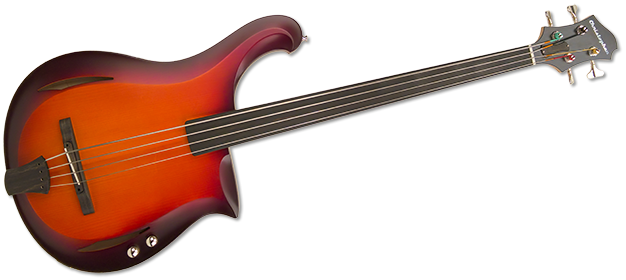
Smith Creek Mandolin “Christopher”
Double Bass Guitar

CONFIGURATION
| Strings: | 4 |
| Style: | Single-cut |
| Overall Length: | 47” |
| Body Dimension: | 22 ½” long x 16” wide at lower bout |
| Body Contouring: | Minimal |
| Weight: | 7.8 lbs |
MEASURES
| Scale length: | 34” |
| Neck width at nut: | 1.554” |
| Neck width at 12th fret: | 2.228” |
| Neck width at joint: | 2.450” |
| Neck thickness at nut: | .925” |
| Neck thickness at 1st fret: | .900” |
| Neck thickness at 12th fret: | .995” |
| Neck thickness at joint: | 1.03” |
| String spacing at nut: | .403” |
| String spacing at saddle: | .734” |
| Fingerboard radius: | 12” to 20” compound (nut to saddle) |
| Descriptor for neck shape: | D |
| Peghead break angle: | 5 degrees |
| Bridge break angle: | 13 degrees |
| Afterlength at nut: | 2.4” to 5.37” |
| Afterlength at saddle: | 2.103” to 2.491” |
| Attachment: | set neck |
| Pocket gap: | none |
| Truss rod type/access: | compression rod / peghead end |
| Fret count: | N/A |
| Fretwire: | N/A |
ELECTRONICS
| Pickups: | K&K piezo transducers |
| Pickup location(s): | Underneath bridge and attached to soundboard |
| Electronics: | K&K 2-channel preamp |
| External Controls: | Volume, Volume |
| Internal Controls: | Gain, Bass, Mid, Treble (for each channel) |
| Shielding: | N/A |
| Preamp circuit voltage: | 9v |
CONSTRUCTION
| Body Material: | Poplar body core, with carved red spruce top and flamed maple back |
| Neck Material: | Maple |
| Fingerboard: | Ebony |
| Body Finish: | Nitrocellulose lacquer |
| Neck Finish: | Nitrocellulose lacquer |
HARDWARE
| Strings: | D’Addario Heliocore Pizzicato (double bass strings) |
| Attachment: | Proprietary tailpiece and tailgut anchor |
| Bridge/material: | Proprietary / Graphtech TUSQ |
| Nut: | Graphtech TUSQ |
| Tuners/color: | Schaller / nickel |
| Knobs/color: | Metal / nickel |
| Pickguard: | N/A |
| Control cavity cover: | Plastic |
GENERAL
| Company: | Smith Creek Mandolin 46 Summer St. Westerly, RI 02891 (401) 787-6302 www.smithcreekmandolin.com dave@smithcreekmandolin.com |
| County of origin: | USA |
| Warranty: | Limited lifetime |
| Price: | $2,750 |
| Options: | AA top and back ($300), AAA top and back ($500), Master Grade top and back ($800), Ruthenium-plated hardware ($100), G&G hard shell case, instead of Studio Slips gig bag ($75) Accessories: Studio Slips padded gig bag, bridge-setting jig, truss rod adjustment wrench |
| Available colors: | Brown Mahogany Sunburst, Reddish Mahogany Sunburst |
| Acquired from: | Smith Creek Mandolin |
| Dates: | Winter 2017 to Summer 2018 |
| Locals: | Ohio |
| Test gear: | Rob Allen Mouse, Kay C-1, Bergantino Forte, Bergantino HT112ER, Reference 210 and CN212 cabs, Fender Rumble Stage 800 |
TEST RESULTS
1-5 (unacceptable to impeccable)
In-hand
| Features: | 4 |
| Tonal Flexibility: | 4 |
| Ease of Use: | 5 |
| Aesthetics: | 5 |
| Ergonomics: | 4 |
| Tone: | 5 |
| Value: | 4 |
In-hand Score 4.43average
On-bench Score 4.13average
On-bench
| Overall construction | 4 |
| Wood choice | 5 |
| Materials choice | 5 |
| Joinery | 5 |
| Fretwork | N/A |
| Fit and Finish of adornments | 4 |
| Quality of finish work | 5 |
| Ease of repair | 3 |
| Potential range of setup | 3 |
| Balance on knee | 4 |
| Balance on strap | 4 |
| Overall electronic quality | 4 |
| Solder joints, wire runs | 5 |
| Clarity | 4 |
| Noise | 4 |
| Shielding | N/A |
| Quality for Price Range | 3 |
SONIC PROFILE:
Low: Open, yet controlled; warm and woody, but articulate
Mids: Warm yet clear; reminiscent of upright bass in attack
Highs: Clear without being harsh
TONE-O-METER:
The Christopher Bass can definitely do a great job of copping the tone of a plucked or slapped upright bass, but it actually has a wider tonal palette available than you’d get from an upright.