This Article Was Originally Published On: December 15, 2015 #Issue 17.
The Company Line
Paul Reed Smith, like some other luthiers and builders, started out doing repair. His shop was in Annapolis, Maryland, but he eventually gained the reputation that would draw all the especially challenging work to him from all over the Washington, DC area. Paul got into lutherie out necessity… he simply couldn’t afford to purchase anything “worthy” to play. His first guitar was built in 1976 as a challenge to one of his college music professors for class credit, though at that time, Paul already knew he wanted to build guitars, anyway, so it was already a foregone conclusion and an easy challenge to win (word on the street is the professor may have also known that, and if so, that means he did what any good teacher would do, encouraging a student to tap an obvious gift). He was awarded an “A,” which simply fortified his decision to officially pursue the craft. This officially happened in 1985 with the opening of a 5,500-square foot factory located in Annapolis. It was built specifically for making guitars, with excellent environmental controls for temperature and humidity. The initial growth of the popularity of his guitars was probably best driven by Carlos Santana, though it was fortified by Paul being industrious about taking a guitar to show all the big bands that came to town at the time (not to mention the work put in to make a truly great and obviously worthy guitar). Artists using his guitars early on also included Ted Nugent, Howard Leese (Heart), Al DiMeola, and many others. The business has grown since then and expanded product lines. Today, his current facilities are utilizing over 100,000 square feet to get it done, and the list of top artists playing his instruments is not only growing, but notably iconic.
Paul is particular about detail and process. He has wood buyers whose full-time job is to find wood for his guitars that meets his strict selection criteria. When it comes to finishes, each guitar’s individual wood character actually determines the method or approach to staining for best results. Literally, different processes are used, depending on the nature of the wood. He designs and makes his own pickups so as not to be “restricted” from his desired level of experimentation and continuing to push the tone bubble forward. He describes the guitar as the “singer” and the pickups as the “microphones.” I found that interesting, and accurate, though I’ve never thought of it that way before. When it comes to design and construction theory, he says his body shape is essentially a combination of the Gibson Les Paul, Jr. and Fender Stratocaster, and that he was essentially inspired by anything that went through his repair shop that “sounded good.” He even went to violin makers for input.

The SE line is PRS’ entry into the affordable and entry level (though still very worthy) bass market. They were designed in the Maryland shop, but are built overseas. I love how so many top builders these days are coming up with entry level offerings which are not only affordable, but do a good job of representing that builder’s design goals.
Paul has known Gary Grainger for years, and even still, today, plays in the “PRS band” with him. He began collaborating with Gary on a 5-string model back in 2003, but the design has been refined since then, and expanded to include a 4-string model, which is our review piece, here. The resulting Grainger basses, introduced at the 2013 Winter NAMM Show, are full-on, top-of-the line PRS. The PRS website states, “The Grainger 4 is the evolution of our Private Stock Grainger Bass line. As the primary designer of our Private Stock basses, Gary (John Scofield, Dennis Chambers, Frank Gambali, etc.) collaborated with many bass artists, including Wyzard (Mother’s Finest) and Kevin Walker (Justin Timberlake), to create a Core PRS bass with all the character and quality of Gary’s Private Stock models, but with a more universal appeal.” I’d simply say it’s very obvious that a lot of time and consideration were put into this design, with great attention to detail, and an ambition to do something fresh and new.
Details
Let’s start with the Kestrel. This is an import model, made by World Musical Instruments of Korea, to PRS’ specification, which was introduced in June of 2014, along with a dual-humbucker sister model (the Kingfisher). They call it a “vintage-inspired” model. It borrows from a traditional Fender Jazz Bass in that the controls are strictly passive. It has dual volume controls, one for each pickup, and a single passive tone control. It also utilizes a traditional 34” scale, with 22 frets, only comes in 4-string models, and utilizes a pair of “J-style” single-coil (PRS designed “4B S”) pickups. Where it differs from the traditional is that it supports through-body stringing, has a high-mass TransTone bridge from Hipshot, and is a neck-through design. The neck itself is a 5-ply maple-walnut design, with maple on the outsides and in the center, with the walnut “stringers” between those larger pieces of maple. The fingerboard is rosewood, with cream binding and traditional PRS bird inlays. The tuners are also Hipshot HB6 (Ultralite). The strap buttons are traditional chrome, but are a fairly unique oversized design that I’m sure hold a strap especially well. That’s pretty much it for the nuts and bolts.
Now, on to the crème de la crème, the Grainger.

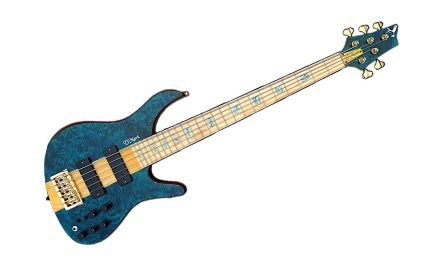
This is also a 34” scale bass, though it has 24 nickel frets. The neck attachment on this bass is a bit different for a set-style attachment. There’s kind of a “platform” which extends under the heel of the neck, much like a bolt-on neck might have, except there are no bolts, of course. PRS’ 513 guitar uses the same neck attachment, and I’ve read that Paul feels it enhances the low end and provides “more of a single-cut sound from a double-cut guitar.” On basses, I typically find a single-cut design translates to enhanced sustain and tonal purity. The quarter-sawn maple neck has a rosewood fingerboard, and a satin finish. The neck profile is pretty svelte and is a proprietary “GG4” shape. The body is solid mahogany, and the top is carved figured maple (classic PRS thing, there). You can get flamed or quilted maple for a top, and you can also select an upgrade to a “10” top, if you like (though the same wood/figures). The bridge is a proprietary PRS bent-plate style bridge with brass saddles, and a really cool anchoring system, where the strings anchor at the base plate, instead of the back plate. This improves the break angle of the string, fortifies the back plate by leaving more material in it, and makes string changing easier, with less risk to body finish damage. The tuners are also PRS proprietary; light and small, very smooth and precise. The strap buttons are also PRS’ own design, a kind of “oversized flat” button. I consider them to be about as good as having locks, honestly, and are not as hard as I’d have expected to get a new strap over. The knobs are black metal knurled domes.
Next, the electronics. This is where it gets interesting. The Grainger features a three-band EQ (bass, mid, treble) with a unique passive mode implementation. Both volume knobs are push/pull. Each/either one engages passive mode, but if you only pull one, it not only switches the whole bass to passive, but it solos that pickup (the other non-pulled volume knob does nothing). To use both pickups in passive mode, you have to pull both knobs. Where I feel like I’m missing something, however, is in passive mode, you don’t have a tone control you can use. This is not unique – there are other basses on the market that offer a passive mode with no passive tone control – but I definitely prefer to have it. Other than that, however, the (proprietary) 18v EQ is very clean and intuitively voiced. The entire preamp has a pre-emphasis of 2.5dB of bass boost and 4.5dB of treble boost. The bass is a fixed shelving boost/cut with a wide Q at 20Hz to 170Hz. The midrange is a fixed parametric boost/cut with a wide Q centered at @ 450Hz. The treble is a fixed shelving boost/cut with a wide Q at 2kHz to 20kHz. This might read as gobble-dee-gook to some, but the net result is that it’s a powerful EQ which covers a very broad range of the frequency spectrum, offering a great amount of musical control – all with only three seemingly simple controls. The batteries are easily accessed via battery boxes on the back. The pickups are proprietary GG4 treble and bass pickups, utilizing a bar design (as opposed to pole pieces), and I have to say, they have a lot of output, and look impressive.

Fit and finish
The Kestrel represents great work and attention to quality. The people in Korea did Paul proud, especially noting the price point. I can’t find any runs or flaws in the paint, the lines (such as around the binding) don’t show any gaps or bends. The binding covers the fret tangs nicely, the body shaping is smooth and consistent, and the neck heel is very comfortable. The Hipshot hardware of course performs flawlessly. The pickguard is cut and fits well. The wiring looks pretty standard for a pickguard wire job, and the cavity is painted with shield paint, connecting to some foil under the pickguard to complete the shield can for the controls. The strap buttons are large and grip a strap well, but don’t make it impossible to get a non-broken-in strap on and off. The neck is straight and adjusts well, and the fret level is very good.
The Grainger is top-of-the-line PRS, meaning all the little things people ogle PRS guitars for, they’ll do the same for on this model. It’s simply beautiful. I couldn’t find a single flaw under a fine-tooth comb. The finish is flawless, beautiful and deep. The top has what’s known as a “scraped binding” around the edge. It’s where the luthier literally scrapes off the finish, or masks it before finishing, giving the illusion of a wood binding that matches the grain in the top, when in fact, it’s literally just the edge of the top, itself. Everything about the bass feels fantastic. I’m a huge fan of this GG4 neck profile. It feels “fast.” I managed to have this bass through some pretty serious environmental swings, and the neck stability is truly superior. I definitely adjusted the Kestrel, where this one simply didn’t need it. I’m normally a fan of strap locks, and have my favorite brand. But I have to say, for a non-locking design, these buttons work really well. They grab a strap hard, aren’t impossible to get through a brand new strap. I also really like their take on a bent-plate bridge, anchoring the strings underneath instead of at the back plate, providing a better break angle, and I’m sure improving tone/sustain. The wiring is very clean, but I have to say, I’m surprised to find no shielding foil or paint. As a firm believer in the benefits, I’d really like to see some shielding.
On the gig
The Kestrel felt and sounded much like a Fender Jazz Bass, with just a couple exceptions. The neck profile is a little less “round,” especially at the nut, and of course, with the neck-through design, there’s no bolt-on neck joint when you get above the “money area” on the bass. Other than that, it does the rest… It balances great on the strap, the neck pickup is fat, the bridge pickup burps and growls, and when blended, it’s the funk tone the majority of the people out there are most familiar with. At 9.5 pounds, his bass felt a little on the heavy side for a 4-string with a slightly more compact body shape than a J-bass, but not bad. The controls worked smoothly and as expected. The passive tone control also worked as expected, emphasizing the mids and dropping the high end as you rolled it off.
The Grainger, at 9.1 pounds, was slightly easier on the shoulders, but again, it balances so well – especially on a strap – it’s not really noticeable, and I do think right around 9 pounds or so is a nice sweet spot for basses. I love the neck profile on this beauty. It nearly plays itself, and I’m a huge fan of satin (or oil-rubbed) neck finishes, so the satin finish this bass has is right in my wheelhouse. It takes a phenomenal setup, and it just feels great on a strap. Both pickups represent, with huge versions of the big fat neck pickup sound and the burpy, edgy, growly bridge tone. Blended, it’s one of the biggest and richest funk tones I’ve ever heard. The EQ is voiced perfectly for the pickups and is very clean and usable. The neck pickup is pretty fat and full sounding all by itself, so I rarely used any EQ on it at all, except to back the treble off for a little bit more of an old-school type tone. I imagine a little mid boost would add some cut/edge, but I never felt it needed it. The bridge pickup is one of the more full-sounding bridge pickups I’ve played, but you add just a bit of bass to it and it gets downright big. I personally wouldn’t use the mids with this bridge pickup, but I could see backing the treble off to get a bit more of a “Jaco-esque” tone from it (not the same, just add some similarity). In short, this bass cuts a mix and cuts it in style. I feel like it’s got its heart based on funk, but it’ll knock down rock, country and jazz with no problem at all. About the only thing I found a bit difficult to get used to was the way the passive mode was implemented. I really prefer to have a more global passive/active switching model, and in passive mode, I also like to have at least some tone control via classic passive tone control. About the only other thing I’d like to see is to add shielding to the control cavity. Given the quality of venues someone who could afford this bass might play, noise may not be an issue. But for the average clubber, we need the extra protection. Still, that’s kinda’ nitpicky, but when you’re dealing with an instrument of this caliber, I think it’s appropriate to be a little persnickety.

The Bottom Line
All things considered – features, price, quality – both of these instruments represent deals that are damn hard to beat. Yeah, the Kestrel’s a pretty basic instrument, but it’s built extremely well, is based on probably the most popular electric bass model ever made, represents its tone well, and is pretty painless on the pocketbook. It’s inexpensive enough for a beginner and quality enough for a regular gigger.
The Grainger is a whole new thing. Some things I may have done a little differently, but there’s absolutely no arguing the craftsmanship, tone, and playability. It does everything Paul and Gary set out to accomplish, and does it extremely well. It has its own sound, and it’s a very good thing. I would love to see Paul make even more basses, such as a 5-string Kestrel, and a 5-string high-end model that was a little bit more mainstream with the electronics. But what PRS has to offer as of right now is certainly very enticing. Speaking of which, I have to go now… I want to spend a little more time playing these jewels before I button them up and send them back.

PRS SE Kestrel
GENERAL
| Company: | Paul Reed Smith Guitars 380 Log Canoe Circle Stevensville, MD 21666 USA Phone: 410-643-9970 Emails: custserv@prsguitars.com http://www.prsguitars.com/ |
| County of origin: | Korea |
| Warranty: | Non-transferrable, limited lifetime |
| Price: | $749 |
| Options: | N/A |
| Accessories: | Embroidered logo gigbag, tools |
| Available colors: | Black, Red Metallic, Tri-Color Sunburst |
| Acquired from: | PRS |
| Dates: | Spring 2015 |
| Locals: | Illinois, Ohio |
| Test gear: | Gallien-Krueger Neo112-II, Gallien-Krueger MB Fusion 800, Aviom |
TEST RESULTS
1-5 (unacceptable to impeccable)
In-hand
| Features: | 3 |
| Tonal Flexibility: | 3 |
| Ease of Use: | 4 |
| Aesthetics: | 3 |
| Ergonomics: | 3 |
| Tone: | 4 |
| Value: | 5 |
In-hand Score 3.57average
Low: Round and full
Mids: Burpy and focused
Highs: Crisp and clear
TONE-O-METER
This bass is PRS’ take on a budget J-bass. It’s got the funk, it’s got the punch, it plays great, and it comes in at a very affordable price.

PRS Gary Grainger 4
GENERAL
| Company: | Paul Reed Smith Guitars 380 Log Canoe Circle Stevensville, MD 21666 USA Phone: 410-643-9970 Emails: custserv@prsguitars.com http://www.prsguitars.com/ |
| County of origin: | USA |
| Warranty: | Non-transferrable, limited lifetime |
| Price: | $2999 ($2699 average street) |
| Options: | Maple fretboard, pickguard, ramp, and “10 top” |
| Accessories: | Hard case, tools. |
| Available colors: | Natural and various paint finishes |
| Acquired from: | PRS |
| Dates: | Spring 2015 |
| Locals: | Illinois, Ohio |
| Test gear: | Gallien-Krueger Neo112-II, Gallien-Krueger MB Fusion 800, Aviom |
TEST RESULTS
1-5 (unacceptable to impeccable)
In-hand
| Features: | 4 |
| Tonal Flexibility: | 4 |
| Ease of Use: | 4 |
| Aesthetics: | 5 |
| Ergonomics: | 4 |
| Tone: | 4 |
| Value: | 3 |
In-hand Score 4.00average
Low: Clear, focused and rich
Mids: Aggressive and cutting
Highs: Glassy and swee
TONE-O-METER
This bass is unique in many ways, it borrows from classic and modern designs, and could easily cover any style of music in fine form. It’s got its own sound, but it’s an extremely good one!