




Regular readers will remember our review of the Becos CompIQ Stella Pro MK2 back in 2024, a compressor that quickly became a firm favourite here at Bass Gear Magazine. So, when Becos told us they’d followed it up with the CompIQ YUNA Pro Compressor, we couldn’t wait to get one on the bench and in front of the camera.
You’d be forgiven for assuming that, because the two pedals share a chassis and a family look, they must sound and behave the same way too. Well, not entirely. YUNA is very much its own compressor, built around the same classic rack-compressor DNA, but streamlined into a simpler, more immediate control set that’s every bit as musical.
What’s Inside Counts
At the heart of YUNA sits the same THAT Corp 4320 Analog Engine® found in Stella, pairing a true RMS (Root Mean Square) level detector with a high-performance Blackmer® VCA. Rather than reacting to instantaneous peaks the way a peak detector would, the RMS sensor averages the signal over time, much closer to how our ears actually judge loudness. The result is compression that tracks your playing dynamics naturally, rather than clamping down mechanically.
Simply Does It
Where Stella gave you a full studio-style control set of separate Ratio and Threshold knobs, YUNA takes a different, refreshingly direct approach. The Comp knob, inspired by the classic DBX 163 “More” compressor, links ratio and threshold internally into a single control marked simply Less to More. Wind it up and you get progressively more compression; because the behaviour is signal-dependent, there’s no fixed ratio or threshold tied to any knob position, but that’s rather the point. The lower half of the range gives a gentle, almost optical-style compression, while pushing further round delivers a punchier, more upfront effect without ever losing clarity, thanks to YUNA’s soft-knee response throughout.
Shape Shifting
An internal jumper lets you choose between Feed-Forward and Feed-Back side-chain modes, effectively giving you two different-sounding compressors in one enclosure. Feed-Forward is the default, offering fast, precise control that can push up to 20:1 for serious limiting duties. Flip to Feed-Back and you get a smoother, airier, more vintage-flavoured compression with less outright punch but a very musical feel. As with Stella, both modes stayed commendably quiet in my tests, with no unwanted noise or artifacts creeping in even when I leaned on the compression hard.
Compress the signal and, naturally, you pull down the overall level, so a Make-Up Gain control is on hand to restore it, offering up to +26dB of gain to play with. Push the Comp knob hard, particularly in Feed-Forward mode, and you’ll want to reach for this control to keep your output level consistent.

On The Face of It
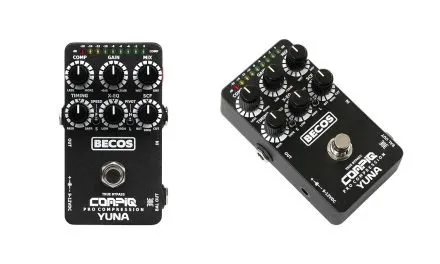
Six main controls make up YUNA’s front panel, and Becos deserve credit for offering a top-tier effect in an uncluttered and more “general user friendly” layout. Rather than fussing over milliseconds and decibels, YUNA is about dialling in a great sound quickly. Top left is that Comp control, and beside it, Gain for make-up level. The top-right knob is a Dry/Wet Mix, blending your uncompressed signal back in with the compressed sound. We’ve talked at length about parallel, or “New York style,” compression in the Stella review, and it’s just as useful a tool here. Dial in a hefty amount of compression to lift your quieter passages, then blend back some of the dry signal to recover the transient punch and realism of your original tone. You can make the compression all but disappear to the ear this way, right up until you switch it out and realise just how much heavy lifting it was doing.
Below that sits the Timing control, and this is where YUNA’s designer Costel shapes its personality. Rather than separate Attack and Release knobs, Becos combine both into a single reversible control. Turn it left and you get a faster attack with a slower release, the classic compressor behaviour most players are used to. Turn it right and that relationship flips to a slower attack with a faster release, which captures percussive transients a beat later and then lets go of them quickly, giving a punchy, dynamic feel more usually associated with separate attack and release controls. It’s a great match for slap bass and other percussive playing styles. Roll it back the other way for fingerstyle playing, and you can let more of the natural transient through for a more realistic pluck. A Speed toggle switch sits alongside, offering a Fast range (5-50ms attack, 50-250ms release) for razor-sharp, surgical compression, or a Slow range (15-80ms attack, 80-400ms release) for a more relaxed, vibey feel.
For tone-shaping, YUNA inherits Stella’s excellent X-EQ control, a tilt-style equalisation circuit inspired by classic ’70s hi-fi gear. Set at noon it’s out of circuit entirely; wind it left and you gently boost lows while cutting highs, wind it right and that relationship reverses, boosting highs and cutting lows. It’s a lovely way to counteract any tonal shift introduced by compression, or simply to sculpt your overall sound. A Pivot switch sets the centre point of that tilt at either 300Hz, better suited to bass, or 1kHz, which favours guitar, though as ever with Becos, either instrument can make a case for either setting. Around the back, a DIP-switch Voicing feature adds further tonal options: Spark brightens things up for a bit of polish, Tight dips the low-mids for added depth, and engaging both together gives a Punch setting with a tube-like warmth that pairs particularly well with the optional DITOS (Direct Injection Transformer Output Stage) transformer output, should you include the option at the time of ordering your Becos compressor pedal.
Expert Level Functionality Made Easy
As bassists, one of the features we most appreciated on Stella carries over here too: the ability to tweak YUNA’s behaviour to suit specific instruments, such as our bass guitars. YUNA’s Side-Chain Filter, on the bottom right of the panel, lets you cut or boost low frequencies in the “copy” of the signal that triggers the compression circuit, without touching your actual output tone. Drop-tune through a preamp with plenty of low-end boost dialled in, and those low frequencies can dominate the side-chain, triggering compression that swallows your higher harmonics and leaves the sound feeling muffled. Cut the lows out of the side-chain here and the compressor balances lows and highs far more evenly, restoring punch and clarity. Turn the knob the other way and you boost those same low frequencies in the side-chain, instead, extending the compressor’s sensitivity downward, which is a great trick for taming thin-sounding single-coil pickups or other low-output sources.
Across the top of the pedal, just as with Stella and the rest of the CompIQ range, an 8-LED gain reduction display gives instant visual feedback on how hard the compressor is working. It’s one of the most common complaints we hear from bassists about compressor pedals generally: no visual indication of what’s actually happening under the hood when in noisy environments. Becos have addressed that neatly here, and while it’s always worth trusting your ears over the meter, it’s reassuring to have that confirmation at a glance when needed.
Plug In Baby
In terms of connectivity, YUNA keeps things simple: a ¼” input, a ¼” output, and a DC power connector, which also doubles as the pedal’s power switch when a jack is inserted. It’ll run from a standard 9-12VDC supply or an internal 9V battery, and as with Stella, ordering the pedal with the optional DITOS transformer-coupled balanced DI output board takes over the space used by the battery. Our review unit didn’t come fitted with DITOS, so I’d point you back to our Stella review for full impressions of what that module brings to the table sonically, but the short version is that it’s well worth exploring if direct injection is part of your workflow. I actually love the subtle colour that the DITOS module adds, I would request that Becos adds that as standard in the circuit, it’s that good!
Construction
Build quality is exactly what we’ve come to expect from Becos: exemplary workmanship, a rugged, compact aluminium enclosure, true bypass footswitching, and a surface-mount build inside centred around that same top-tier THAT Corp compression chip. It really is remarkable how much technology Becos have packed into such a small footprint. Oh, and clear, uncluttered labelling! What more could you ask for?
Rounding Up, Does It Deliver the Goods?
So, where does that leave YUNA next to its sibling? Stella remains the deep-dive, more studio-oriented tool, for players who want to get hands-on with individual ratio, threshold, attack and release settings. YUNA trades some of that granular control for simplicity and speed, wrapping the same high-quality THAT 4320 engine into a control set that gets you to a great-sounding result faster, without ever feeling dumbed down. For gigging bassists and guitarists who want pro-level compression without the deep-dive, YUNA is a stunning, high-end compressor pedal, and another excellent addition to the CompIQ range from Becos. It is by far one of the best compressors I have used and reviewed with a cheeky bloom when you hit it in the sweet spot.


| Specification | Details |
|---|---|
| Manufacture: | BECOS |
| Website: | https://becosfx.com/ |
| Model: | CompIQ YUNA Pro Compressor Pedal |
| Controls: | Comp, Timing, Speed, Make-Up Gain, X-EQ, EQ Pivot, Side-Chain Filter, Dry/Wet Mix, Voicing (internal DIP-switch), RMS Reference Level (internal jumper), Side-Chain Feed FF/FB (internal jumper). |
| I/O: | One ¼" input, one ¼" output, one DC power input. |
| Impedance: | Input impedance: > 1.1MΩ Output impedance: ~100Ω |
| Output frequency response: | 0dB from 30Hz - 22KHz |
| Circuit Topology: | Analogue |
| Housing: | All metal. |
| Dimensions: | Length: 61mm, Depth: 102mm, Height: 51mm 220 gr. / 245 gr. with DITOS DI |
| Power Supply: | 9-12 VDC ±10%, centre negative, with a DC power plug having Ø5.1/2.1mm, 12mm long barrel. (9V battery, without DITOS module installed) |
| Current Draw: | < 45mA @ 9VDC; < 55mA @ 12VDC |
| Warranty: | 3-year direct-to-manufacturer international - See website terms |
| Price: | €219 without DITOS €279 with DITOS £259 without DITOS £319 with DITOS Order directly or request details of regional distributor. |