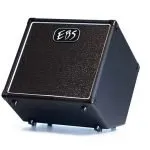
Phil Jones Bass has long been known for offering bass enclosures featuring some of the smallest primary drivers in the industry. They have been offering up some of the smallest bass combos for nearly as long, with products such as the Briefcase, Flightcase, Bass Cub and Double Four breaking new ground in the arena of compact, high-fidelity bass amplification. Taking these trends to what is perhaps their logical conclusion, last year, PJB went big on going small and introduced the ultra-compact X4 Nanobass bass combo, featuring a single 4” driver driven by a 35-watt amplifier. The X4 Nanobass features a 3-band EQ, Bluetooth connectivity, and compliments the driver with a 100mm by 100mm passive radiator located on the rear of the enclosure.
Needless to say, we were very eager to get our hands (and ears) on this mini-marvel to see what it can do.
The Phil Jones Sound
When Phil Jones Bass products first hit the scene back around 2002, they certainly garnered a lot of attention based upon their use of multiple, smaller (initially, 5”) drivers. My first exposure to a PJB product was the legendary Briefcase, which I owned for many years (only to be replaced by the Flightcase BG-150). Soon after picking up the Briefcase, I met Phil Jones at the NAMM Show, and spent a lot of time in his booth, trying everything he had on hand. My first official PJB review was of the Suitcase (and matching 4B extension cab) back in Guitar World’s Bass Guitar Magazine. I later reviewed the M-300 and Neo-Power 8B cabs for Bass Gear Magazine, and I have owned and played many more PJB products.

One thing I can say after playing a ton of PJB gear is that there certainly is a “Phil Jones sound.” First and foremost, it is clean and clear. There are no large peaks or valleys in the mids, but what really stand out are the tight, fast lows, and the decidedly “non-brittle” highs. I have noticed these characteristics in every piece of kit I have tried from PJB, and I am a big fan. If you like to keep things tight, balanced and clean, then leave the EQ set flat and you are good to go. But this kind of “blank canvas” approach definitely lets you add whatever coloration you might want via EQ or effects or whatever trips your fancy. In fact, while the Phil Jones Bass brand is designed for and marketed to bass players, I think of PJB gear more as “instrument amplifiers,” because I’ve piped keyboards, guitar, drum machines, and even streamed audio through my PJB gear with great results.
So, does the X4 deliver the Phil Jones sound? Indeed, it does, though with its own minor twists. Compared to my older Neo-Power gear, it is a tad bit brighter (with no EQ), though not as bright as the PJB Ear-Box (which is meant to focus on the upper frequencies). Interestingly, in regard to the low end, it does have that tight/fast low-end thing going on, but you get a bit of added “tangible vibration” from the passive radiator. I’m used to feeling my chair vibrate a bit when I am really cranking a rig loud, but “feeling” low frequency vibrations at a very low level was a bit unexpected and kinda cool!
A Brief Introduction
The X4 Nanobass measures in at 6.3” wide by 7.9” deep by 7.8” tall, and weighs 5.3 lbs. The front panel is dominated by the single 4” driver, and the rear by the slotted grill over the passive radiator. The top of the enclosure is where the action takes place. Across the top of the control panel, we have a single ¼” instrument input, a 3.5mm stereo Aux In, 3.5mm stereo Headphone output, and a small toggle switch for power (with corresponding LED). The middle of the panel features controls for the instrument Input Level (gain) and the Aux/BT gain control, which has a push function for switching between the 3.5mm Aux In and the Bluetooth signal (press and hold the Aux/BT knob to disconnect Bluetooth). A red Clip LED located between the Input Level and Aux/BT will light up when the power amplifier is overloaded (by either input), and a second LED shows blue for Bluetooth input being active and green for the Aux In being active. The bottom row features the Bass, Mid, and Treble tone controls, along with the master Volume control.


The X4 employs Bluetooth 5.0(aptX) – which enjoys significant gains in efficiency, bandwidth and range over its predecessor, Bluetooth 4.2 LE – with an input level of up to 500mFFS. The 3.5mm Aux In supports up to 300mV, and the instrument input will handle signals from 60mV up to 2V. The 3-band EQ consists of a Bass shelf at 100Hz, a Mid shelf at 1kHz (with a bandwidth of 120Hz to 10kHz), and a Treble shelf at 10kHz. All three bands offer boost or cut of up to 15dB. The AC input (located on the right side of the enclosure) can accommodate 100-240V (50/60Hz). A pair of raised handles offer some protection for the knobs/switch if the X4 were to take a tumble. Although it is decidedly cute, the overall presentation and feel is quite sturdy.
Good Things Come in Small Packages
Given its good looks and diminutive size, the X4 looks quite at home on top of your desktop. In fact, most of my early listening was done with the X4 sitting on the desk next to my PC workstation (which happens to be where I do most of my practicing). At one point, though, I set the X4 on the floor, and I was really surprised by the amount of increased volume and low-end output. Yes, I know that any enclosure will show some increased volume/low-end from the boundary reinforcement when placed on the floor, but the X4 seems to benefit from this even more than my other, more conventional small combos.
It’s Good to be Blue
I had my doubts about Bluetooth from its early days, though – gear nerd that I am – I was anxious to try Bluetooth products in the early 2000’s. While these early Bluetooth-enabled products all basically worked, none of them really inspired me or gave me confidence in the longevity of the technology. I have to say, though, that Bluetooth in the 2020’s is a whole new ball game, and so far, 5.0 seems to take it to even greater heights. The increased range is nice if you are using the X4 as a music playback device, while walking around the house/studio/shop with your phone in your pocket. It syncs up fast, and the sound quality is excellent. The tone controls and master Volume have no effect on the Bluetooth or Aux In inputs.
What It Is; What It’s Not
At first glance, it is undeniable that the X4 is certainly cute, and it has a compelling “hipness” factor. But after getting past the initial “gotta have it!” feeling, I do think it is valid to ask whether or not you really need a $360 1×4” combo amp. After spending some quality time with the X4 Nanobass, I feel that I can answer that question in both the affirmative and the negative, based upon your needs and expectations. First up, let’s talk about what it does well. It’s a great practice companion, and not just for bass guitar. I can see just about any stringed instrument (guitar, violin, cello, etc.) playing quite nicely with the X4. It’s a great tool for learning new songs or playing along to prerecorded music. It’s great for practicing/playing with headphones (more on this below), and it’s also great for playing without a set of cans on your ears – but also without disturbing everyone else in the house. It’s a pretty good straight-up Bluetooth playback device. Oh, and did I mention that it’s cute?

One thing the X4 is not – at least not for me, in any conceivable fashion – is a gig rig. To be clear, PJB doesn’t market it as a gigging amp, but whenever I get a new toy to play with, I like to see how far I can push it beyond its intended use. That being said, I can’t think of a single musical act I have seen in any setting where the output from the X4 would be enough to carry the day. Perhaps a very intimate show to a handful of people in your immediate vicinity would work, but in that same situation, something like an acoustic bass guitar or full-body upright bass would be louder. To be fair, the overall output and particularly the low-end output is more than we should reasonably expect from a single 4” driver, but it does have its limits. Phil Jones has played fast and loose with the laws of physics with many of his designs, but even Phil can only push these immutable laws so far. I was a little disappointed to see that there is no line-out function, other than possibly the 3.5mm headphone out. I have a PJB Neo-Power PB-300 (powered 6×5), and I was really hoping that I could plop the X4 on top (like I do with my Flightcase BG-150) and have the PB-300 up the ante. That being said, if I really was going to bring a smaller PJB combo out to a gig, with or without the PB-300, I would bring my BG-150 (or you could use the Bass Cub Pro, Double Four, or even the Micro 7, all of whom have a Line Out function).
The headphone output merits a bit more discussion. So many devices seem to have a headphone output that we take these little output jacks for granted, but they are not created equal. I am a bit picky in this regard (again – admitted gear nerd), and I typically use a PJB Bighead Pro [insert link to review]. I was a bit surprised when I switched from my Bighead Pro to the headphone jack on the X4 and initially heard no drop in quality or volume. After a good bit more A/B-ing, the Bighead Pro does have a bit more oomph down low with my larger electrostatic cans, and slightly better imaging, but the competition was a lot closer than I expected.
A Deeper Dive: Q&A with Phil Jones
To get some additional insight into the engineering and design choices behind the X4, I decided to present some questions to the man, himself, Phil Jones. If you have ever had the pleasure of speaking with Phil directly, you will immediately recognize his admittedly long-winded, but always informative and interesting style of answering questions.
Q: The X4 Nanobass is marketed as a bass combo; did you have other instruments in mind when you designed it?
A: At the very beginning, we wanted a tiny amp that could handle any instrument. While being a bass amp, it is also much more. With its flat and full frequency range response and high-fidelity tone, it is ideal for most instruments. It has become quite popular for a broad range of stringed instruments and players now endorsing it include guitar virtuoso John Jorgenson and violinist Andrea Young. Acoustically, I knew the design would work, as I had meticulously calculated every detail. But bringing it to production was a whole new challenge. Our first priority was to keep it within budget, so that it could hit the right price point. We were determined to give the unit a solid feel, so we used the same high-quality covering that we use on our larger models. We use a sprayed epoxy paint for a flawless finish. It is a more expensive method compared to traditional Tolex covering, but we always believe in spending money wisely to deliver the best for our customers. We developed a method using vinyl covering that gave the corners a polished look, so now the X4 has a striking resemblance to our larger models.
Q: What was your original design goal with the X4?
A: Our initial design goal for the X4 was to create a microscopically sized amplifier that would truly captivate discerning musicians who prioritize the tone of their instrument, especially in situations where a larger, more powerful amp is not necessary. We envisioned a portable solution that could be easily carried in a backpack, perfect for traveling musicians who need to practice or play in diverse locations, from unplugged rehearsals to impromptu jam sessions. And it was essential for us to achieve exceptional tonal quality, even for bass instruments, without compromising on compactness and portability.
Q: Is there anything that surprised you throughout the process of designing and manufacturing the X4 Nanobass?
In nature, things that are small tend not to produce low frequencies. A lion might roar, but a mouse cannot; he just squeaks! To get a mouse-sized amplifier to roar was going to be the greatest challenge. The physics of this amp just go against all the laws of physics. We didn’t break any laws, but we intelligently optimized every component to match exactly. The amplifier was tailored to match the speaker unit and the speaker unit was matched precisely to the enclosure loading to give a sense of realism to the sound of the bass. As we decreased the box size, we had to revisit the fundamental laws of speaker design. Efficiency was paramount, so we developed a new driver that incorporates the most powerful neodymium magnets available.
The most important frequencies to a listener when he hears bass are between 100Hz and 3kHz. This is where most of the information lies. Below 100Hz, you are hearing pure fundamentals that give the bass weight. Above 3kHz is where you hear the newness of round-wound strings and the percussive transients of slapping a bass. Bass is different things to many people. At the extreme, you have crazy stupid car audio systems the rumble out 20-30Hz frequencies, but that is not where the bass guitar sits in the range. In old school days of record players, it was very unlikely to get deep bass on vinyl records for mainly economic reasons, due to:
- Physical limitations: Vinyl records have physical limitations in terms of how low and how loud they can reproduce sound. The grooves on a vinyl record are limited in size and depth, which means that low-frequency sounds require more space to be accurately reproduced. This limits the overall amount of bass that can be captured on a record.
- The costs of production: To produce deep bass on a vinyl record, a larger amount of vinyl is needed. This increases the cost of production, as well as the weight and size of the record. This can make the record more expensive to produce and transport, which may not be economically feasible.
- Playback equipment: To reproduce deep bass on vinyl records, specialized equipment is required. This includes high-quality turntables, tonearms, cartridges, and amplifiers. These components can be expensive, which makes it difficult for the average consumer to afford.
In the mastering process, bass frequencies were cut below 40Hz, which is probably why 5-string basses were rare during this period (because it was almost impossible or very expensive to accurately reproduce the low B string accurately). Over the years, bass has become more prominent and also deeper in pitch. Go back to listening to albums of the ‘60s and ‘70s and you know what I mean. When digital came out at consumer level, it was no longer difficult to record or replay bass very low frequencies.
The X4 Nano can’t play really deep bass, but it can give some weight to the instrument, as it can play to around 60Hz and then it cuts off. Saying that, many bass guitar speakers actually roll-off well above that frequency. I have made several measurements in the past on acoustic upright basses looking at the spectrum analysis. An acoustic upright bass does not have anything below 100Hz coming from it. Yes, the low E is more than an octave lower, at 41.2Hz. But you still hear it a full-bodied instrument, although not very loud. In terms of the specific frequency range that is most commonly associated with bass in music, it can vary depending on the genre and production style. In general, bass frequencies in music tend to be centered around the 40Hz to 120Hz range, with the lowest notes of the bass guitar or double bass typically falling around 30Hz to 60Hz. The kick drum in electronic music may have a fundamental frequency around 60Hz to 80Hz, while the bass in hip-hop or EDM may emphasize frequencies in the 80Hz to 120Hz range. The fundamental frequency of the bass can be important for creating a full and rich sound; it’s often the harmonics and overtones of the bass that are more audible and contribute to the overall impact of the bassline in a piece of music. Therefore, even if the fundamental frequency of the bass is not present or audible in a recording or mix, the higher harmonics and overtones can still provide the listener with a sense of fullness and richness in the bass sound.
The loudspeaker’s immutable law of design.
There is a hard rule of designing bass speakers. If you want loud, you have to sacrifice low frequency output or simply make a massive cabinet. Bass guitar speakers are compromised because musicians want them to be loud and portable. If you want a fairly small box to reproduced the low frequencies, well, then you must sacrifice efficiency; but now, we have powerful and affordable class-D amplifiers, known as PWM (pulse width modulation) switching amps. There are so many advantages to using class-D amps for bass. First, the price per watt is extremely good value. Second is the lightweight and compactness of the units. D class amps are around 80-94% efficient in comparison to older class-AB amps that run below 50% efficiency. More power is able to power the speakers and less as heat and less heat improves reliability.
The X4 takes all the advantages of class-D amps and the latest technology on high-power magnets on the speaker and calculating the best overall extended low-frequency limit by coupling the rear of the speaker to a passive radiator. A passive radiator works almost like a vented box, but without any air turbulence that causes vent noise. Also, it would be impossible to use an enclosure this size by using a vent, as the vent would simply take up to much internal volume to work and therefore increase the box size.
We had to use neodymium magnets because even a slight increase in physical size of the magnet size would have compromised the bass output of the speaker, as the larger size would have taken up too much internal air volume, thus reducing the low frequency output. The driver is only 4 inches across, but it is a masterpiece of engineering and PJB is the first company ever to use N52 neodymium magnets for loudspeakers, which are the most powerful permanent magnets available.
The difference in magnetic strength between our N52 and the loudspeaker industry standard N35 magnets is significant. N52 magnets are the crème de la crème, with a maximum energy product of approximately 52 MGOe, making them the strongest commercially available neodymium magnets. N52 magnets are a whopping 17 MGOe stronger than N35 magnets. [TECH NOTE: MGOe refers to the maximum amount of magnetic energy that a magnet can store per unit volume in a magnetic field measured in Gauss, and is calculated by multiplying the maximum magnetic field strength (measured in Gauss) by the coercivity (measured in Oersteds) of the magnet.]
N52 magnets are capable of producing a far stronger magnetic field for a given volume, which makes them more effective at driving the voice coil in a loudspeaker. In addition to their higher magnetic energy product, N52 magnets also have a higher coercivity than N35 magnets. This means that they are less likely to demagnetize over time, which can be a concern in high-powered loudspeaker systems. The higher coercivity presents a more stable magnetic field when high-current alternating signals run through the speakers voice-coil eliminating any “flux modulation” caused from high-power alternating currents, resulting in a cleaner and more linear loudspeaker across its whole dynamic range. In other words, the magnet field does not flex, even under high-power inputs, resulting in a more defined clarity and punch.
The X4 may be small in size, but it’s packed with advanced materials, cutting-edge manufacturing techniques, and the highest quality components. It’s built with the precision of a fine watch, leaving no room for even a pinhole where air could escape. This attention to detail and craftsmanship gives the X4 its performance that punches way above its weight class. It’s not just a regular amplifier; it’s a true masterpiece of engineering.
Tell me a bit about the evolution of the drivers which you use at PJB. What are the primary differences, sonically and performance-wise, between the 4” and 5” drivers? What other changes have you made over the years?
As you may know, I am a bass player with an engineering background in electronics. My love for the instrument has led me in the direction of sound engineering. For ten years, I was involved in large-scale sound systems for concerts of up to 15,000 people in London.
I owned my own concert sound company, and what set me apart from others was my commitment to always producing the highest quality sound, both in dynamics and frequency range. In 1980, I designed massive horn-loaded 2×18 inch JBL woofers loaded onto 17-feet long folded Hyperbolic flared horns. In the 1980s, power amps were not yet powerful enough to get high SPL from rectangular vented direct radiator enclosures. High efficiency was crucial in producing powerful bass and using a horn over direct radiator could increase the SPL by over 10dB. That is like having ten times the power in amplifiers The only way to achieve this was through horn-loaded enclosures. One reason for the increased efficiency of a horn-loaded woofer is that the horn can effectively transform the impedance of the driver, allowing it to more efficiently transfer energy to the air. This can result in a higher output of sound for a given amount of power input My first job in speaker design was with Vitavox in 1980, where I learned to design compression drivers, woofers, and horn-loaded enclosures. I also learned about the manufacturing production processes there including the fabrication of multicellular horns. I have over 50 years of experience in designing, measuring and manufacturing loudspeakers. When I started PJB, I followed a different path in designing bass guitar speakers than any other competitor. My knowledge of bass guitars and sound reproduction gave me insight into designing radically different speaker enclosures, although our amps followed the philosophy that amplifiers should be a true constant voltage source to achieve the best bass performance.
I spent several years convincing many people that my philosophy worked. Now, we have passed the stage of having to prove its effectiveness, and it works very well. Initially, we wanted to build drivers that could easily handle the frequency range and punishment dished out by a bass guitar to speakers. For a completely full-range speaker system, you’re looking at a response from 30Hz to no more than 15kHz. Frequencies above and below this range are just noise. My decision to start using 5-inch drivers was obvious to me. First, the midrange from such a size speaker can have a flat response and sound beautiful. Second, by designing the suspension system, motor structure, coil, and cone assembly, we were able to meet this frequency range. But the magic happens when you use them in multiples. First, the efficiency increases due to an effect called mutual coupling. It’s a bit like 1+1=3.
The power of a speaker is determined by the physical size of the voice coil. All modern speakers fail at around the same temperature, due to the materials being used. For example, the enamel on copper wire breaks down at around 250°C. I’m sorry, as a Brit, I often use the metric system! It doesn’t matter if it’s a 10-watt speaker or a 1,000-watt speaker; they all fail roughly at the same temperature, due to coil burnout. In general, loudspeakers are more efficient heaters than sound reproducers, and most of the amplifier power is used to heat up the speaker voice coil, at least 95% of it! Small coils have much less surface area to radiate heat away, and you can say that the power handling of a speaker is proportional to the radiating area of a voice coil. The voice coil is the Achilles’ heel in a speaker. It is one of the smallest components, but has to take all the power from the amplifier and translate it into acoustic output through electro/mechanical/acoustic means.
[TECH NOTE: There are two limits of power a speaker has to deal with. First is thermal; just how much the coil heats up until it fails. The second is excursion limit, and this is the sheer amount of mechanical movement the cone can endure before failure. On vented loudspeakers, this limit is exacerbated below the vent resonance as this is where the cone excursion increases significantly. This usually results in the cone tearing apart from the surround. And 5-string bass players who use those lower notes are more prone to damaging their speakers than 4-string bass players. But that is another story I can go into sometime…]
So, when you have an enclosure with many small loudspeakers, the combined radiating area may well be the same as a single driver. For example, our C8 or C9 cabinets are basically equal in cone area to a single 15-inch or 2×10-inch, but the combined coil area is much greater than that of a single or dual-speaker enclosure. This equates to a lower working temperature of the voice coils in PJB cabinets, which not only increases reliability – because heat is the enemy of reliability – but also improves the dynamic range and transient response. I won’t go into this any more for now, but have we made changes to our drivers over the years? Yes, of course, and we continually do so in the quest for the perfect bass tone.
At the very beginning of PJB, we invested in a Klippel Laser loudspeaker measurement system. This gear cost more than an average house in the USA, but there is no other way to find out how to improve loudspeaker drive unit design. It won’t tell you how to design, but it will give you the most honest and sometimes brutal truth about what you are doing wrong. I would also say that if you don’t use a Klippel system to design drivers, then you really are at a great disadvantage in today’s speaker industry.
Every single PJB design has been created through the use of the Klippel measuring system in combination with Brüel & Kjær (B&K) acoustical measurements in our very large anechoic chamber. The Klippel system gives an in-depth analysis of:
- Frequency response: The system can measure the loudspeaker’s frequency response, which describes how the loudspeaker performs at different frequencies. This includes measurements of on-axis and off-axis response, as well as polar response.
- Distortion: The system can measure various types of distortion, including harmonic distortion, intermodulation distortion, and nonlinear distortion, which can affect the accuracy and fidelity of loudspeaker performance.
- Voice coil parameters: The system can measure the voice coil parameters, such as impedance, inductance, and resistance, which are crucial for understanding the electrical behavior of the loudspeaker.
- Thermal behavior: The system can measure the thermal behavior of the loudspeaker, including voice coil temperature and power handling capabilities, which are important for assessing the loudspeaker’s reliability and durability.
- Mechanical parameters: The system can measure mechanical parameters of the loudspeaker, such as excursion, compliance, and damping, which are critical for understanding the loudspeaker’s mechanical performance and limitations.
Brüel & Kjær (B&K) is a Danish company that specializes in the design, development, and manufacture of high-precision sound and vibration measurement equipment. The company was founded in 1942 by Per Brüel and Viggo Kjær and has since become a leading provider of measurement solutions for a wide range of industries, including aerospace, automotive, electronics, and environmental testing. Each PJB design is centered around a solid foundation of engineering and sound physics. Therefore, we have different-sized speakers (4-inch, 5-inch and 7 -inch), depending on what the systems application is intended for, and also for what budget.
An Unfair(?) Comparison
In addition to referencing other PJB gear, I also wanted to see how the X4 stacked up against another, newer practice amp – in this case, the ($230) Fender® Rumble™ LT25. At first glance, this looks like an unfair comparison, considering that the LT25 dwarfs the X4, being nearly twice as tall, more than twice as wide, more than three times as heavy, and sporting an 8” driver. Once you power them up, though, the X4 flips the script and sounds more balanced, full, solid, and the useable frequencies seem to extend deeper than the Fender. The X4 definitely highlights that the LT25 has more peaks and valleys in its frequency response.

The Bottom Line
GENERAL INFO
| Manufacturer: | Phil Jones Bass |
| Website: | www.pjbworld.com |
| Model: | X4 Nanobass |
| Made In: | China |
| Warranty: | 2-year limited warranty |
| Frequency Response: | 72Hz – 15kHz |
| Inputs: | ¼” Instrument, 3.5mm Aux In, Bluetooth, AC input socket |
| Input Levels: | 240mV - 2V (Instrument), 300mV max (Aux), 500mFFS (Bluetooth) |
| Outputs: | Headphone Out |
| Controls: | Input Level, Aux/BT Level (push to select), Bass, Mid, Treble, Volume, Power Switch |
| Bluetooth Version: | 5.0 (aptX HD) |
| Accessories: | Carrying bag sold separately |
| Dimensions: | 6.3” W x 7.9” D x 7.8” H |
| Weight: | 5.3 lbs. |
| Price: | $449.49 list, $359.99 street |